
In pre-hospital emergency care and patient transport, the ambulance stretcher is one of the most relied-upon and frequently used pieces of core equipment for emergency personnel. Yet many stretcher suppliers worldwide continue to address all scenarios with standardized products, forcing emergency teams to compromise when faced with different vehicle models, terrains, and usage intensities. Drawing on more than two decades of experience in emergency equipment manufacturing, Xiehe Medical has built an ambulance stretcher portfolio based on scenario-based design—ranging from basic mechanical models to gas spring-assisted, iron alloy heavy-duty, dual loading wheel, and stainless steel high-frequency disinfection variants—giving EMS distributors and ambulance converters worldwide more targeted options for product selection.
From “One Model Fits All” to “Select by Scenario”: The Logic Behind Ambulance Stretcher Differentiation
Ambulance stretchers on the market often cover all customers with a single model, leaving buyers with limited trade-offs between price and configuration. Xiehe Medical takes a different approach: by breaking down the ambulance stretcher into multiple independently selectable technical directions based on real emergency transport scenarios, distributors can precisely match products to their target markets’ vehicle conditions, usage intensity, and disinfection requirements.
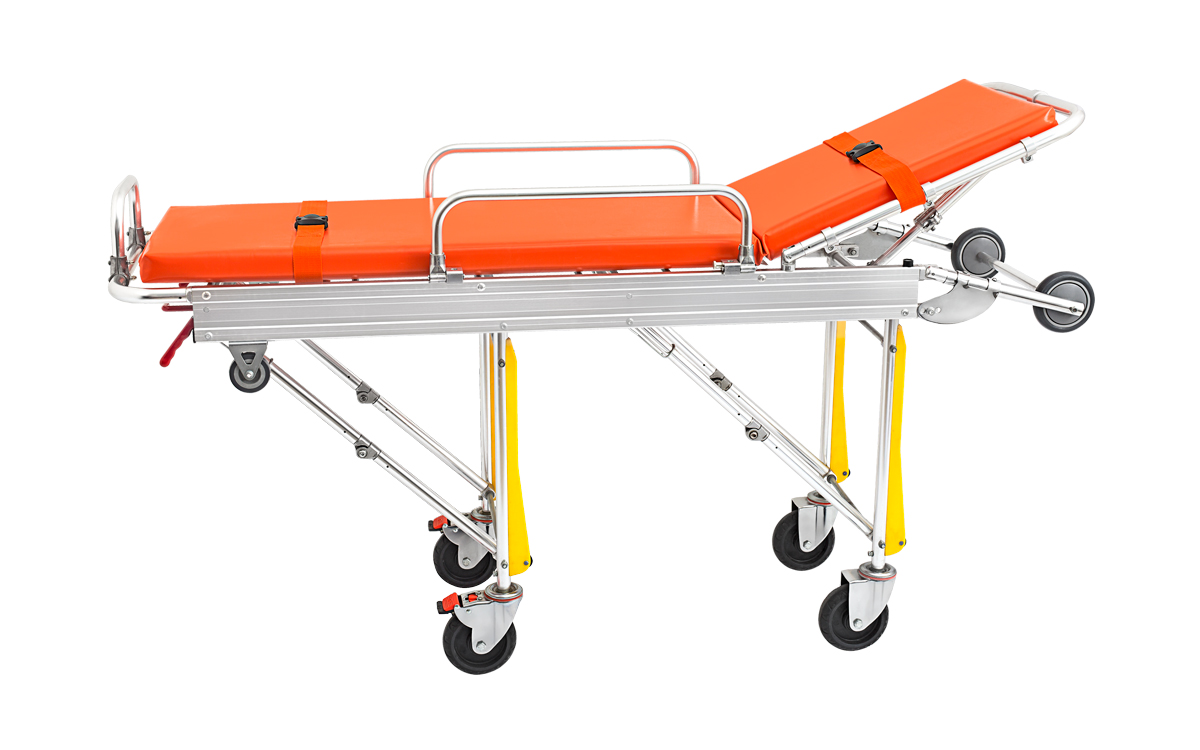
YXH-3B: Gas Spring-Assisted System for Smoother High-Frequency Folding
In emergency centers with high daily call volumes, stretchers may be unfolded and folded dozens of times a day, and the hesitation and operational resistance of mechanical folding legs accumulate into a continuous physical burden on emergency personnel. The Xiehe YXH-3B introduces gas spring assistance into the folding leg system, providing cushioning and assistance during leg folding and deployment for smoother, more effortless operation. The gas spring not only reduces the force required for each operation but also minimizes the impact felt during folding, maintaining a smooth operating experience through frequent loading and unloading. For understaffed, high-call-volume emergency teams, this design translates directly into both operational efficiency and occupational health benefits.
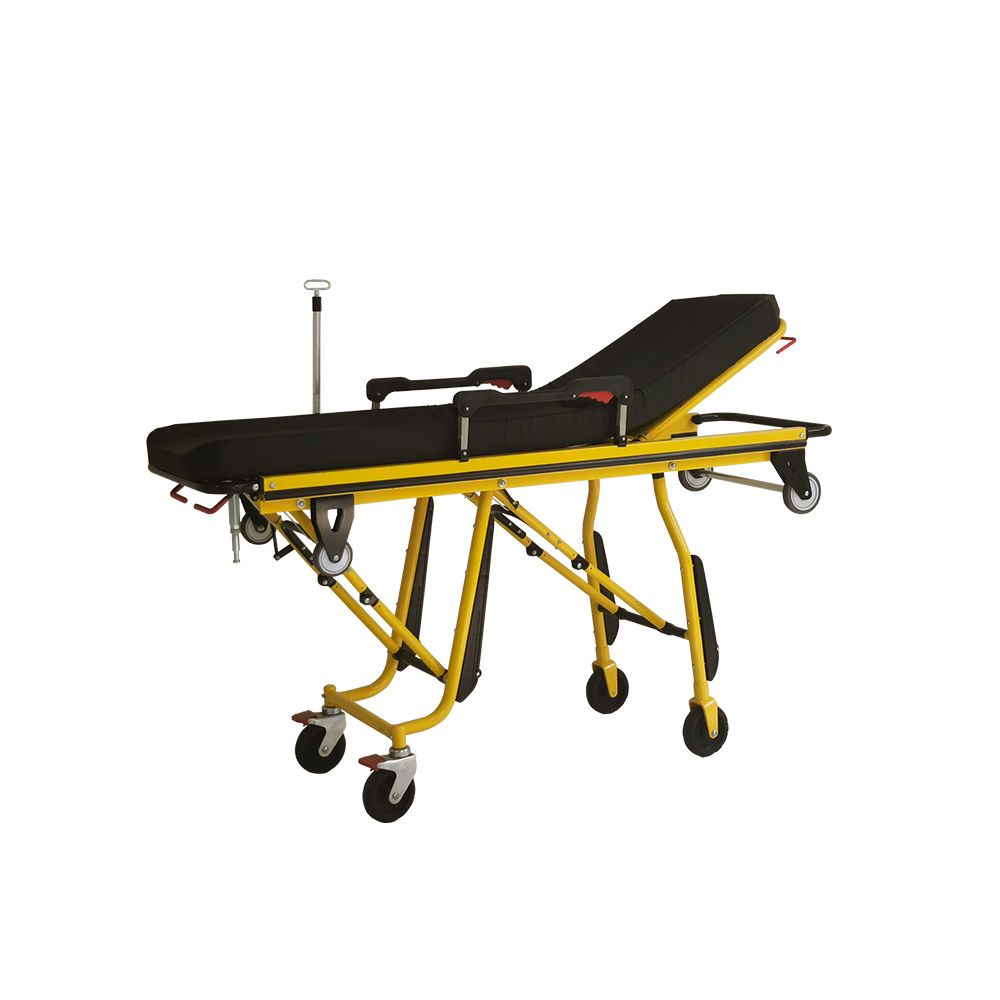
YXH-3C: Iron Alloy Thick-Wall Tubing, Built for High-Intensity Operations
Not every emergency scenario is suited to lightweight aluminum alloy. In regions with high daily transfer volumes, high usage intensity, and complex road conditions, the fatigue resistance of the stretcher frame is often more critical than weight. The Xiehe YXH-3C is manufactured from high-strength iron alloy thick-wall tubing, with reinforced design at key stress points on the frame, resisting deformation and fatigue fracture under long-term heavy loads and repeated loading. The high position of 99 cm and low position of 33 cm match standard ambulance floor heights while allowing patients to be loaded and unloaded at ground level. The structural redundancy provided by the iron alloy material makes it particularly suitable for large hospital emergency departments, military medical evacuation, and high-frequency professional emergency operations where durability requirements are stringent.
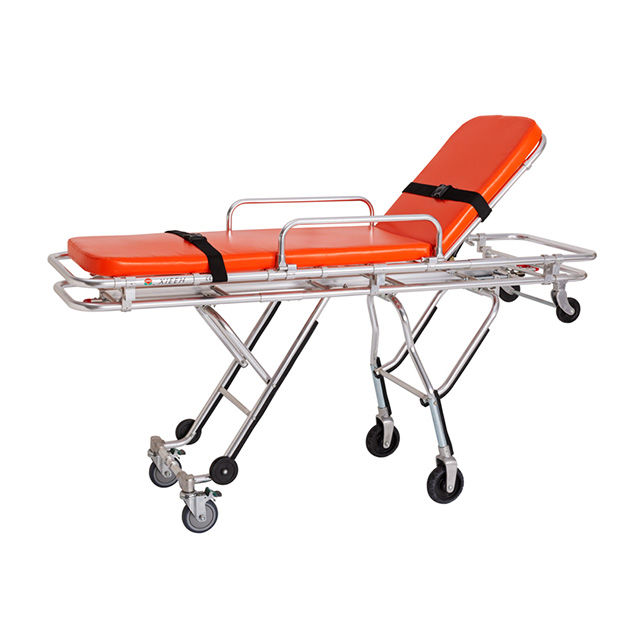
YXH-3D: Dual Loading Wheels to Handle Vehicle Height Differences and Uneven Ground
During ambulance loading, the height transition between the vehicle floor and the ground is often an operational challenge—different vehicle models have varying rear door heights, and slopes, step edges, or uneven surfaces further aggravate the risk of jamming and tilting during loading. The Xiehe YXH-3D adds two additional loading wheels above the main wheels, providing extra support points and guidance at the vehicle floor edge when pushing the stretcher into the ambulance, making the transition from ground to cabin smoother and more stable. This design is particularly practical in complex terrain emergency scenarios such as older residential areas, rural roads, and slope parking, while also reducing resistance and physical exertion during high-frequency loading operations and improving emergency team response efficiency.
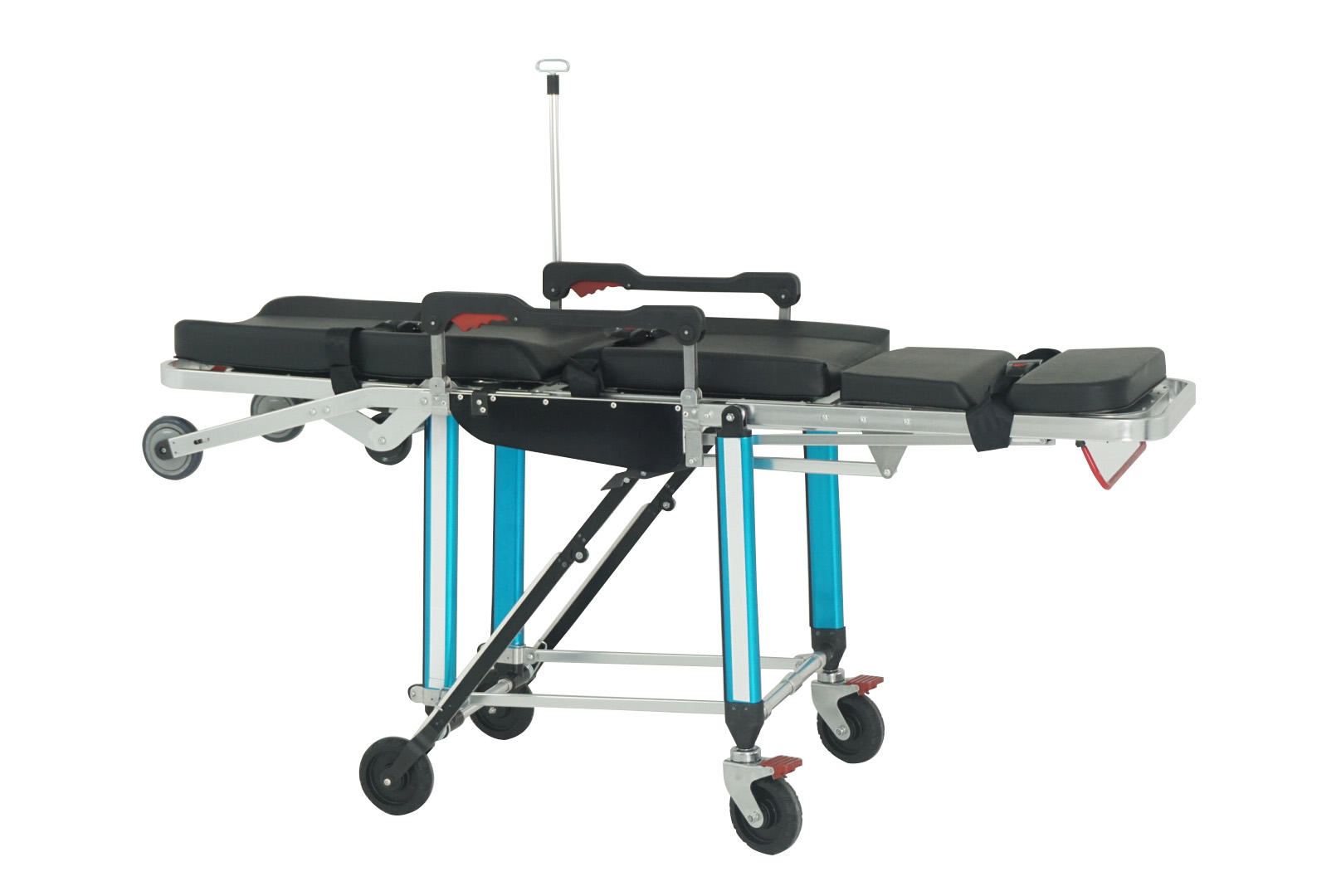
YXH-3E3: 301 Stainless Steel for High-Frequency Disinfection and High-Salt-Spray Environments
In coastal emergency services, infectious disease control, and scenarios requiring frequent high-intensity disinfection, the corrosion resistance of the stretcher material directly determines equipment lifespan and infection control effectiveness. The Xiehe YXH-3E3 is manufactured from 301 stainless steel, offering natural corrosion resistance and withstanding prolonged exposure to seawater, salt spray, chemicals, and various strong disinfectants without rusting or corroding. The material itself does not absorb bacteria or contaminants, and its smooth, dead-corner-free surface enables highly efficient cleaning and disinfection, meeting strict infection control standards in healthcare settings. At the same time, the YXH-3E3 retains the dual stretcher-and-chair conversion function, with chair mode significantly reducing horizontal footprint for flexible operation in narrow elevators, crowded corridors, and ambulance compartments. The heavy-duty 301 stainless steel structure maintains stability under high-frequency use, making it a reliable choice for coastal regions and public health emergency scenarios.
The Manufacturing Foundation Behind the Differentiation
The differentiated designs of these four ambulance stretchers are not isolated technical touches but are built on Xiehe Medical’s unified manufacturing system. All models use high-strength materials and corrosion-resistant surface treatments, are equipped with adjustable backrests, foam padding, and safety restraint systems, and undergo structural integrity and folding mechanism functionality testing before shipment. For distributors, this means they can combine different models within a single supplier system according to their target markets’ actual needs—gas spring-assisted models for high-call-volume emergency centers, iron alloy heavy-duty models for high-intensity operational areas, dual loading wheel models for complex terrain, and stainless steel models for coastal and infection control scenarios. This flexibility of “selecting by scenario” is precisely the channel value that standardized stretcher products struggle to provide.
Conclusion
The technical differences in ambulance stretchers are often hidden in the operational details that emergency personnel repeat dozens of times a day—whether a fold is effortless, whether a loading is stable, whether a disinfection damages the material. Through continuous responses to these details, Xiehe Medical transforms the ambulance stretcher from a single standardized product into a combinable, scenario-based solution, providing global EMS distributors and ambulance converters with more deterministic product choices.

Zhangjiagang Xiehe Medical Apparatus & Instruments Co.,Ltd
Professional manufacturer of first aid products with 20 years of export experience.covering ambulance stretcher,folding stretcher,spine board,etc.
7 Xinzha Middle Road, Yangshe Town, Jiangsu, 215600 P.R.C.
Copyright © Zhangjiagang Xiehe Medical Apparatus & Instruments Co.,Ltd. All Rights Reserved - Privacy Policy

 EN
 AR
 CS
 DA
 NL
 FI
 FR
 DE
 EL
 HI
 IT
 JA
 KO
 NO
 PL
 PT
 RU
 ES
 SV
 TL
 ID
 LT
 SK
 VI
 TR
 FA
 GA
 IS
 HY
 EU
 KA
 HT
 BN
 LO
 LA
 MN
 NE
 ZU
 MY
 KK



 Hot News
